Start with Two Minutes: How Big Habits Begin Small
Make a new habit so small it takes under two minutes. What James Clear's two-minute rule and BJ Fogg's Tiny Habits teach about starting small.

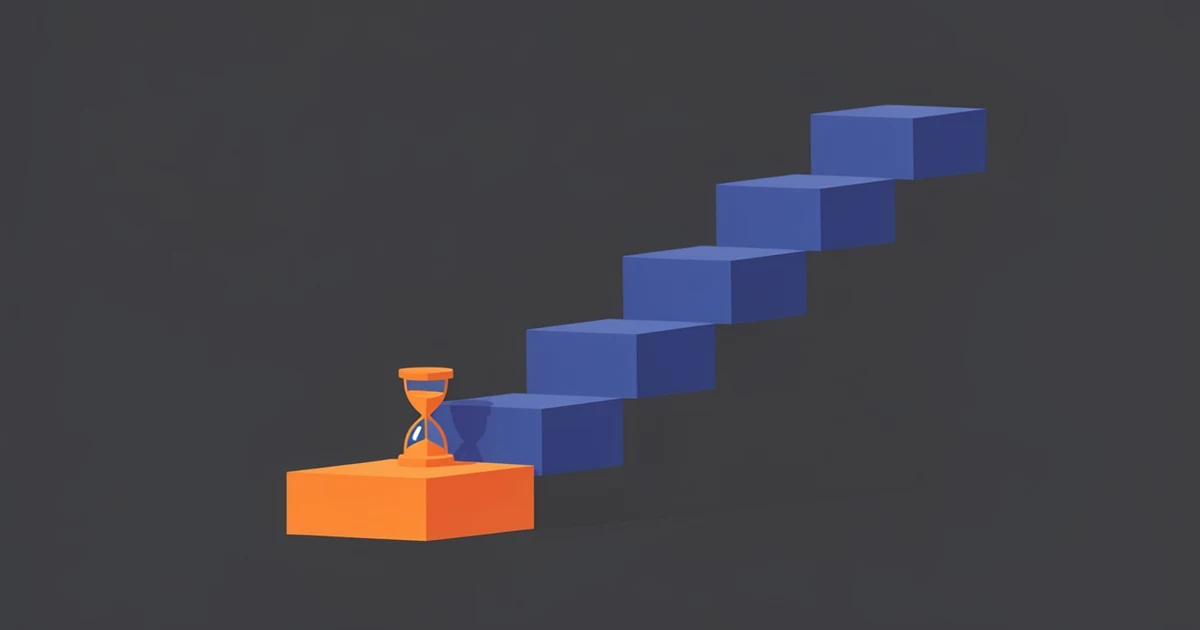
You open the report file at nine and promise yourself the whole introduction before lunch. By ten you have checked email twice, tidied your downloads folder, and the introduction is still blank. The plan was not wrong. It was just too big to begin.
This week is about the opposite move: make the new habit so small that starting feels almost silly. Two of the best-known writers on habits reach the same place from different directions, and their advice fits on a sticky note.
The two-minute rule
James Clear puts it in one line in Atomic Habits: "When you start a new habit, it should take less than two minutes to do." In an excerpt from Chapter 13 of the book, he shows how nearly any habit shrinks to a two-minute version. "Study for class" becomes "Open my notes." "Read before bed each night" becomes "Read one page."
The point is not that one page of reading changes your life. Clear says so directly: the goal is to master the habit of showing up. In his words, "a habit must be established before it can be improved." You have to standardize before you can optimize.
He also gives you a way to find the right size. Put your goal on a scale from very easy to very hard. Take a work report. Finishing the whole report is hard. Writing one section is still hard. Jotting three bullet points is easy. Opening the file and typing the first heading is very easy. That last step is what Clear calls a gateway habit, a small door that leads into the bigger work.
One thing not to mix up: in a footnote, Clear credits David Allen of Getting Things Done with an older two-minute rule, which says that if a task takes less than two minutes, you should do it now. Allen's rule is for clearing small tasks. Clear's rule is for starting big habits small.
Tiny Habits: make it easy, attach it, celebrate
BJ Fogg, who founded the Behavior Design Lab at Stanford, wrote Tiny Habits (2019) on the back of twenty years of research. A good way into his thinking is his model of behavior, which he sums up on behaviormodel.org as B=MAP: behavior happens when motivation, ability and a prompt come together at the same moment. When a behavior does not happen, at least one of the three is missing.
Your motivation on a tired Thursday evening is hard to plan for. How easy the action is, and what reminds you to do it, you can design. Fogg's method works on exactly those parts.
His Tiny Habits recipe card has three slots:
- Anchor moment: an existing routine in your life that will remind you to do the new behavior.
- Tiny behavior: the habit you want, scaled back until it is super tiny and super easy.
- Celebration: something you do to create a positive feeling inside yourself.
You fill it in as one sentence: "After I ..., I will ... Then, I celebrate!"
The celebration is the easiest slot to skip, yet in Fogg's method it does real work. On his page about celebrations, he describes it as something you think, say or do right after the tiny behavior, and explains that the positive emotion helps wire the new behavior into your brain, making it more automatic. It does not need to be big. A quiet "Nice, done" in your head counts, as long as it makes you feel good.
Why the start matters more than the size
Both approaches agree that the hard part of a habit is the first moment, not the middle. Clear writes that once you have started doing the right thing, it is much easier to continue doing it. The more you turn the beginning of a process into a ritual, the more likely you are to slip into deep focus.
There is a quieter benefit too. A tiny habit is hard to break on a bad day. However tired you are, you can still open the file. You can still read one page. The habit keeps its place in your day until you have room to grow it.
If the tiny version feels like a trick you are playing on yourself, Clear offers a stricter form: do it for two minutes and then stop. Not "at least two minutes". Exactly two. It is not a strategy for starting, he says, it is the whole thing. All it asks is that you show up.
Try it this week
Pick one habit you have been putting off. Then:
- Shrink it. Write the two-minute version. "Learn Japanese" becomes "open the app and do one exercise." "Exercise after work" becomes "put on my running shoes." "Work on my thesis" becomes "open the draft and write one sentence."
- Anchor it. Choose a routine you already do every day without thinking: making coffee, sitting down at your desk, closing your laptop at the end of the day. Write the recipe: "After I sit down at my desk, I will open my thesis draft."
- Celebrate it. Decide now what you will say or do right after. Keep it small and honest.
- Keep it tiny for a week. Resist the urge to raise the bar on day two. Growing the habit comes after it is established, not before.
At the end of the week, look back. If you started on most days, the habit has a foothold, and the next step can be a little bigger.
Write the start down with Snipset
A tiny habit still needs a prompt, and a line you will see tomorrow morning is a good one. In Snipset, the Tasks & Todo Menu has a one-line add box ("Add a task…"), so you can type the two-minute version the way you would say it: Open my notes tomorrow 8am #habits. As you type, Snipset picks out the date word, the time, a priority from p1 to p4 and any #tag, keeps them out of the title, and saves them with the task when you press Enter. It is plain pattern matching that knows a short list of words such as today, tomorrow, next week, hari ini or besok, so keep the line simple rather than expecting it to understand any phrase. For more ways to use the menu in a working day, see Notes, Journal, and Tasks in One App.
Keep Snipset in your Google results
Add snipset.belajarcarabelajar.com as a preferred source on Google. Snipset posts then show up more often when you search, with a preferred badge in AI Overviews.
Add Snipset on Google